Experience strategy for Deakin University
Context
I was engaged by Deakin University to lead the experience strategy and redesign of their website, with responsibility for defining the experience vision, informing information architecture, and overseeing delivery.
The ambition was to create an audience-led, insight-driven experience that could set a new standard for the sector.
The situation
The university was working with a complex set of audiences, including prospective students, current students, and other public users, alongside multiple internal stakeholder groups.
There was no unified experience vision, and the existing site needed to evolve to better reflect user needs, address legacy systems, and support more consistent governance.
The challenge was to align a large number of audiences and stakeholders around a clear direction, while delivering a site that could operate effectively at scale.
The work
I led the development of an experience vision grounded in research across audiences, stakeholders, and the broader industry.
This included primary user research, stakeholder interviews, and secondary research, covering around 30 customer subgroups and 8 stakeholder groups. The overlap between customer and organisational needs was made explicit through this work.
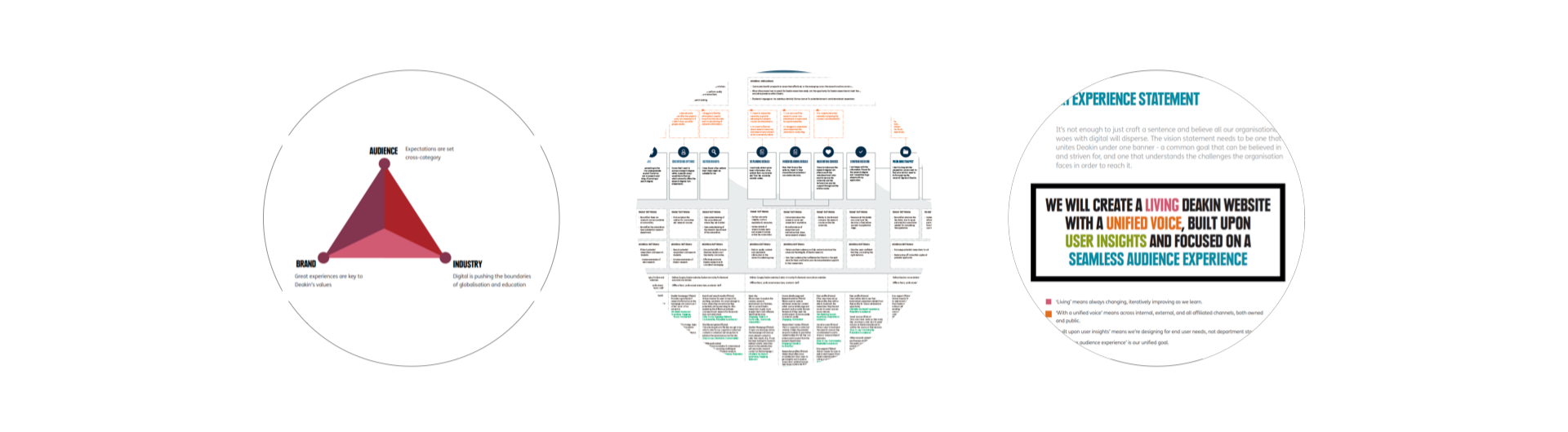
From this, I defined a clear experience vision, supported by 10 measurable experience principles. Each principle was grounded in real examples, including contributions from stakeholders, to ensure shared understanding and practical application.
Experience maps were created for key audiences, alongside additional artefacts such as landscape reviews.
I also developed new workshop approaches to help stakeholders benchmark their current state and engage more effectively with the vision.
Alongside the strategic work, I oversaw the information architecture and design process to ensure alignment with the overall vision as the site was developed.
What changed
The work established a clear and shared experience vision for the organisation, supported by practical principles that could guide decision making.
It enabled alignment across multiple stakeholder groups and provided a foundation for a more consistent and user centred approach to digital experience.
The redesigned website was delivered and launched in September 2016. Read the original press release on B&T to find out more.
What this demonstrates
The ability to lead end to end experience strategy and delivery for large scale digital platforms, aligning vision, research, and execution across complex organisations.