Service design strategy for local government
Context
I worked with a local government organisation in Australia responsible for connecting citizens to a wide range of government services.
The focus was on defining a service design strategy to improve how services are delivered and experienced across the organisation.
The situation
There was no clear link between the organisation’s vision and what a best in class, end-to-end customer experience should look like in practice.
Customer needs and stakeholder priorities were not consistently aligned, and there was limited structure around prioritisation, product definition, and decision-making.
Service delivery maturity varied, with a need to strengthen human centred design practices and improve how experiences were designed and delivered.
There were also broader strategic questions about the organisation’s future role, including whether it should continue delivering services on behalf of others or evolve towards a more consultative and innovative position.
The work
I developed a comprehensive service design strategy, starting with building a clear view of the current state.
This included creating a service matrix covering hundreds of services across multiple departments and touchpoints, alongside establishing agreed customer goals through opportunity scoring and usability review.
A current state service blueprint made visible how customer interactions connected to underlying systems and processes.
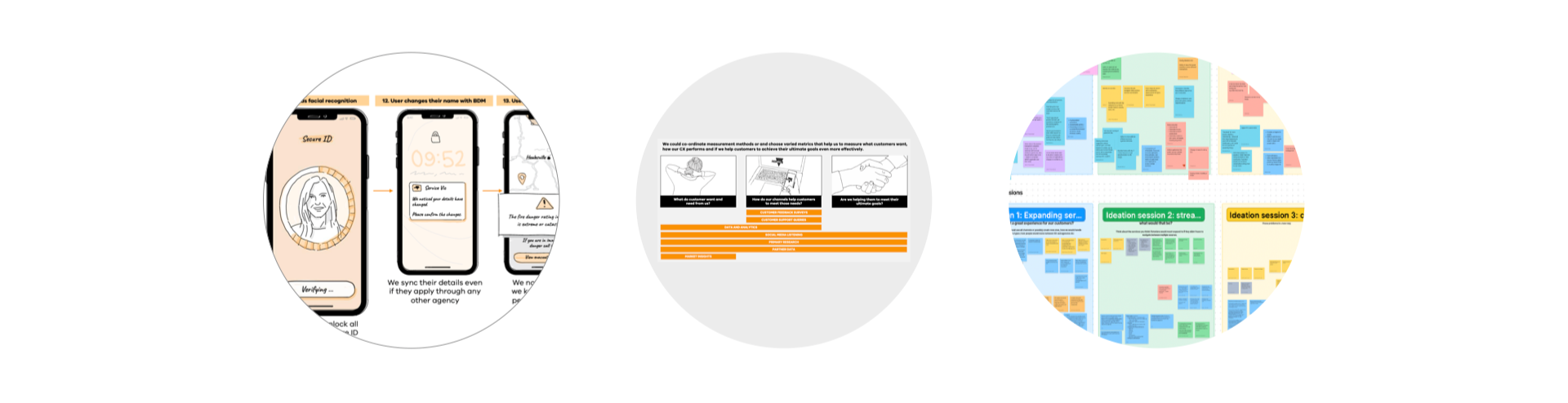
I analysed service delivery practices, with a particular focus on design and product, and worked with stakeholders to generate future state ideas informed by leading digital services globally.
These ideas were translated into storyboards and future state concepts, supported by a clear experience vision.
To enable delivery, I defined prioritisation and measurement frameworks, along with a set of workstreams and an overarching roadmap.
In parallel, I developed guidance and micro lessons to support the design team in adopting more consistent and mature ways of working.
What changed
The work provided a clear and structured foundation for improving service delivery across the organisation.
It introduced new ways of understanding services, prioritising work, and connecting customer experience to organisational processes.
The strategy was well received and has supported a shift in how service design and delivery are approached, establishing a more consistent and intentional way of working.
What this demonstrates
The ability to define and operationalise service design strategy within complex public sector environments, aligning vision, delivery, and organisational capability.