Experience transformation strategy for Bupa
Context
I worked with Bupa to define and shape their approach to customer transformation at a point where there was no unified vision for how it should be delivered.
The situation
At the time, customer transformation was not clearly defined across the organisation.
There was no shared understanding of the current customer experience, how different parts of the organisation contributed to it, or what a future state should look like.
This made it difficult to align teams, prioritise initiatives, and move forward in a coordinated way.
The work
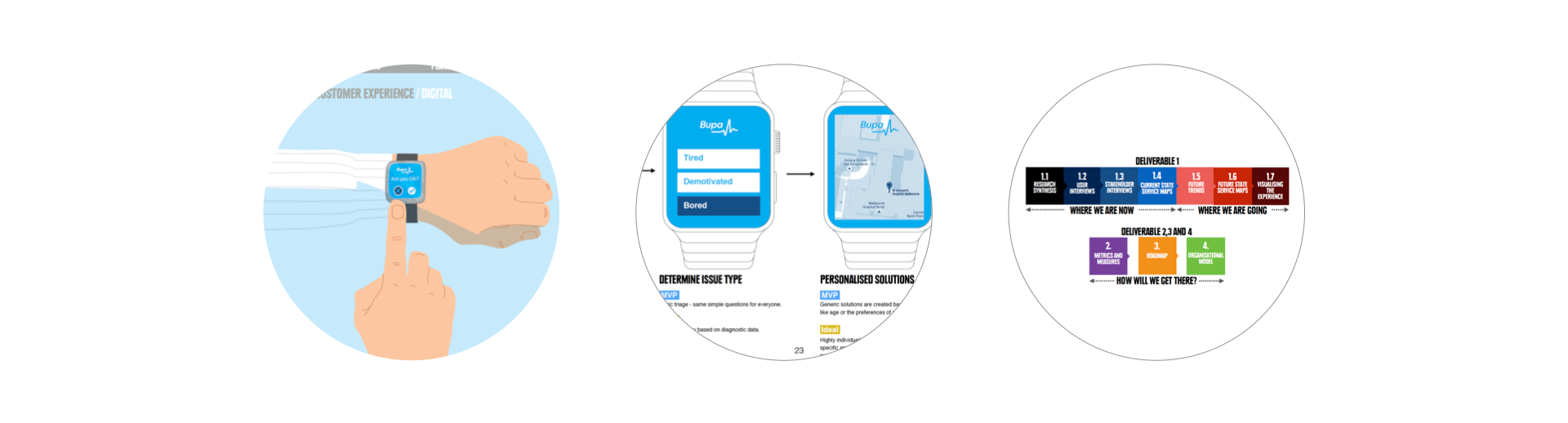
I led a multidisciplinary team to carry out comprehensive customer and stakeholder research, building a detailed view of both customer experience and organisational reality.
This resulted in a service blueprint of the current state, making visible how systems, teams, and touchpoints were connected in practice.
Using this as a foundation, I worked with stakeholders across the organisation to co create a future customer experience vision.
This was informed by emerging technologies and evolving service models, and articulated through a series of customer journeys and screen flows, each grounded in the insights and problems identified in the research.
Alongside the experience work, I developed recommendations for how the organisation would need to evolve to support this future state.
This included changes to team structures, capability development, and ways of working, as well as supporting a broader shift in how customer experience was understood across the organisation.
What changed
The work established a clear and shared vision for customer transformation, grounded in both customer insight and organisational reality.
It provided a foundation for aligning teams, shaping future initiatives, and supporting a shift in how customer experience was approached across the organisation.
What this demonstrates
The ability to define customer transformation from first principles, aligning experience vision, organisational design, and ways of working.